QuantumLearning Machines
New product

QLM LabPath

The AI-guided curriculum where every important idea becomes a lab.

LabPath is the curriculum operating system for V10: the AI chooses the next concept, teaches it, launches the right simulation lab, captures evidence, and adapts tomorrow.

1

Teach first

Every lab begins with the concept, key idea, visual walkthrough, and intention to learn.

2

Then simulate

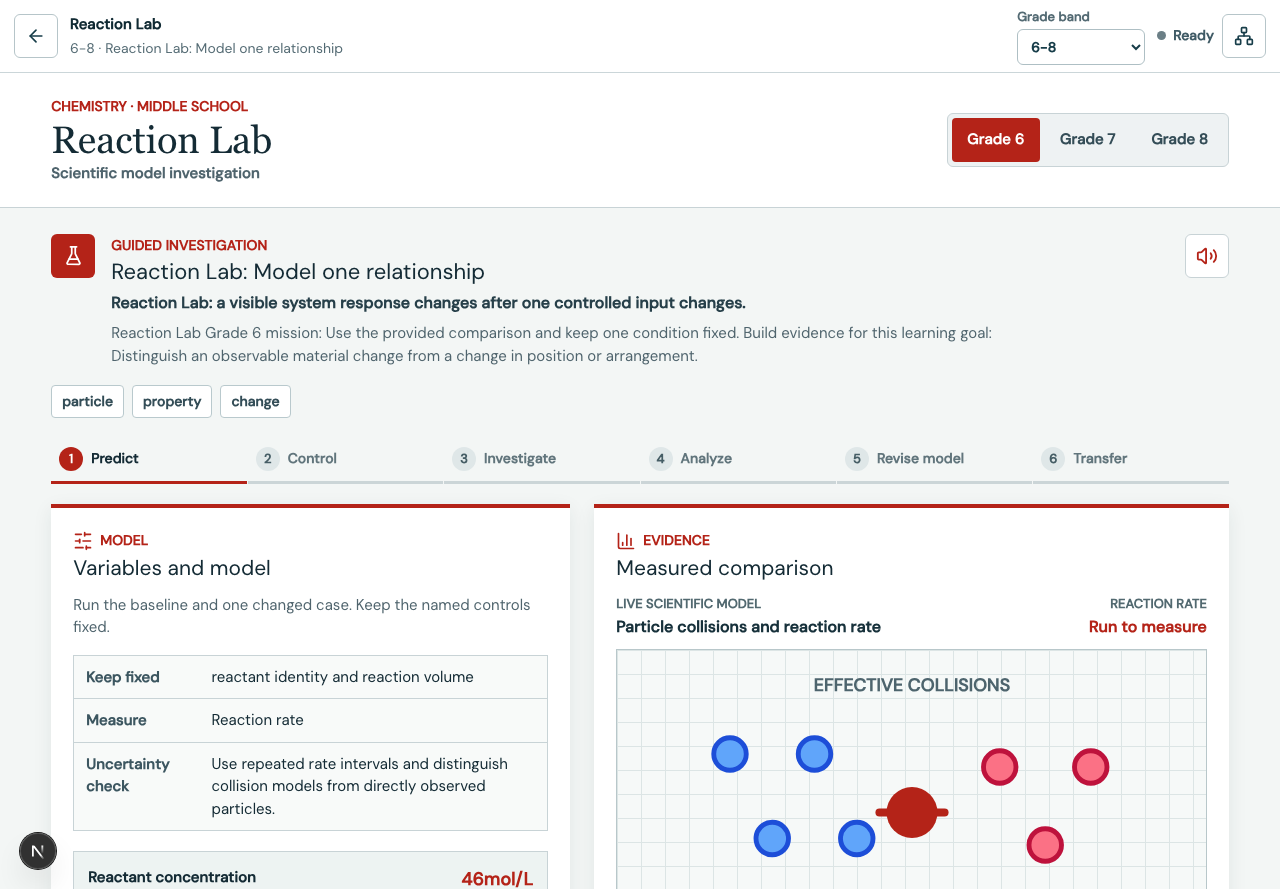
Students predict, act, observe consequences, explain, revise, and transfer in V10 labs.

3

Evidence follows

Each session produces a Learning Evidence Record that updates mastery and the learner profile.

Student

Learn one concept today.

Start with a grade-aware path, learn the idea, run the lab, and leave with evidence.

Start learning
Teacher

Launch a class path.

Create or choose a classroom, share the link, and watch evidence flow into TeacherOS.

Set up class
District or university

See coverage and growth.

Use the same LabPath evidence to inspect curriculum, misconceptions, and intervention quality.

View dashboard
Family

Understand the learning.

See what was practiced, where the child is stuck, and what the next best activity is.

Parent view
Daily learning loop

One clear path. No blank-page learning.

  1. Warm upCheck prerequisites and prior knowledge.
  2. LearnTeach the key idea with visuals and vocabulary.
  3. LabLaunch the grade-aware V10 simulation.
  4. ExplainConvert activity into reasoning evidence.
  5. AdaptChoose tomorrow from mastery, misconceptions, and transfer.
Coverage spine

K-12 through undergrad, with an audit instead of a hand wave.

47V10 mode targets
25K-16 pathways
10/10coverage audit
K-25 pathwaysMath + Science + ELA + History + Engineering + Workforce
3-55 pathwaysMath + Science + Engineering + Computer Science + ELA + History + Workforce
6-85 pathwaysMath + Science + Engineering + Computer Science + History + ELA
9-125 pathwaysMath + Science + Engineering + Computer Science + History + ELA
undergrad5 pathwaysMath + Science + Engineering + Computer Science + History + ELA + Workforce
9/10 coverage gate passed40 unique V10 labs mapped. 9 early-grade pathways use age-appropriate adaptation.
Replacement readiness gate

AP Bio + AP Chem are pilot-ready.

Standard gate: native K-8 tracks, high school/AP/undergrad sequences, live cause/effect labs, TeacherOS pacing, parent/district longitudinal evidence, human validation, and comparative efficacy plan.

9.8/100 blockersNeeds pilot evidence against strong alternatives.
First replacement course

AP Biology LabPath

A full AP Bio course built as weekly inquiry labs: teach the idea, run the V10 lab, capture evidence, defend reasoning, and adapt the next assignment.

8AP units
24lab missions
10V10 modes
10/10replacement v1
8%-11%

Chemistry of Life

How do molecular structure and water chemistry make life possible?

3 labs · moleculeforge + reactionlab + statsphere
10%-13%

Cells

How do cell structures create living function and maintain boundaries?

3 labs · cellworld + bodyatlas + statsphere
12%-16%

Cellular Energetics

How do living systems capture, transform, and regulate energy?

3 labs · reactionlab + cellworld + moleculeforge
10%-15%

Cell Communication and Cell Cycle

How do cells send information, regulate responses, and decide when to divide?

3 labs · cellworld + bodyatlas + clinicalsim
Second replacement course

AP Chemistry LabPath

AP Chemistry is now represented as particle-first labs, wet-lab simulations, solver-backed data, FRQ defense, and TeacherOS misconception repair.

9AP units
27lab missions
10solver engines
10/10replacement v1
7-9%

Atomic Structure And Properties

How does atomic structure explain chemical identity and measured properties?

3 labs · atomic-spectra-workbench
7-9%

Compound Structure And Properties

How does structure determine molecular and ionic behavior?

3 labs · molecular-structure-workbench
18-22%

Properties Of Substances And Mixtures

How do particle interactions explain bulk properties and mixtures?

3 labs · solutions-forces-lab
7-9%

Chemical Reactions

How do reactions conserve atoms while changing substances?

3 labs · stoichiometry-reaction-bench
Depth expansion

Bio proved the standard. Now chemistry, physics, and math inherit it.

Each course now has a replacement-course contract: eight units, twenty-four mission labs, mode-native engines, evidence loops, misconception clusters, and TeacherOS handoffs.

10/10contract gate
24units
72labs
25engines
chemistry

Chemistry LabPath

A full chemistry course where students learn matter, reactions, equilibrium, energy, and analysis by manipulating molecular systems and defending evidence.

8 units24 labs10/10
physics

Physics LabPath

A full physics course where students learn by predicting motion, manipulating systems, reading measurements, and defending models from evidence.

8 units24 labs10/10
mathematics

Mathematics LabPath

A full mathematics path where students learn by manipulating quantities, structures, graphs, proofs, and models until reasoning is visible.

8 units24 labs10/10
Chemistry replacement spine

K-16 chemistry now has a full LabPath ladder.

Chemistry now spans early matter exploration, elementary particle models, middle-school reactions, high-school chemistry, AP Chemistry, Gen Chem I/II, organic, analytical/physical, and a biochemistry bridge.

10/10K-16 spine gate
10course paths
63units
189missions
Whole ladder

K-16 Chemistry LabPath

Matter, particles, reactions, thermochemistry, equilibrium, acids, electrochemistry, organic mechanisms, measurement, and biochemistry bridge missions in one evidence-connected path.

Open K-16 Chemistry
Math replacement spine

K-16 math now has a course-level LabPath spine.

K-8 now has grade-aware scaffolds and concrete manipulative controls. Algebra I, Geometry, Algebra II, and advanced math extend the same evidence loop through undergraduate foundations.

10/10K-16 spine gate
10course paths
60units
180missions
Whole ladder

K-16 Math LabPath

Counting, elementary math, middle-school math, Algebra I, Geometry, Algebra II, Precalculus, Calculus, Statistics, and undergraduate foundations.

Open K-16 Math
K-8 depth layer

Counting, Elementary, Middle School

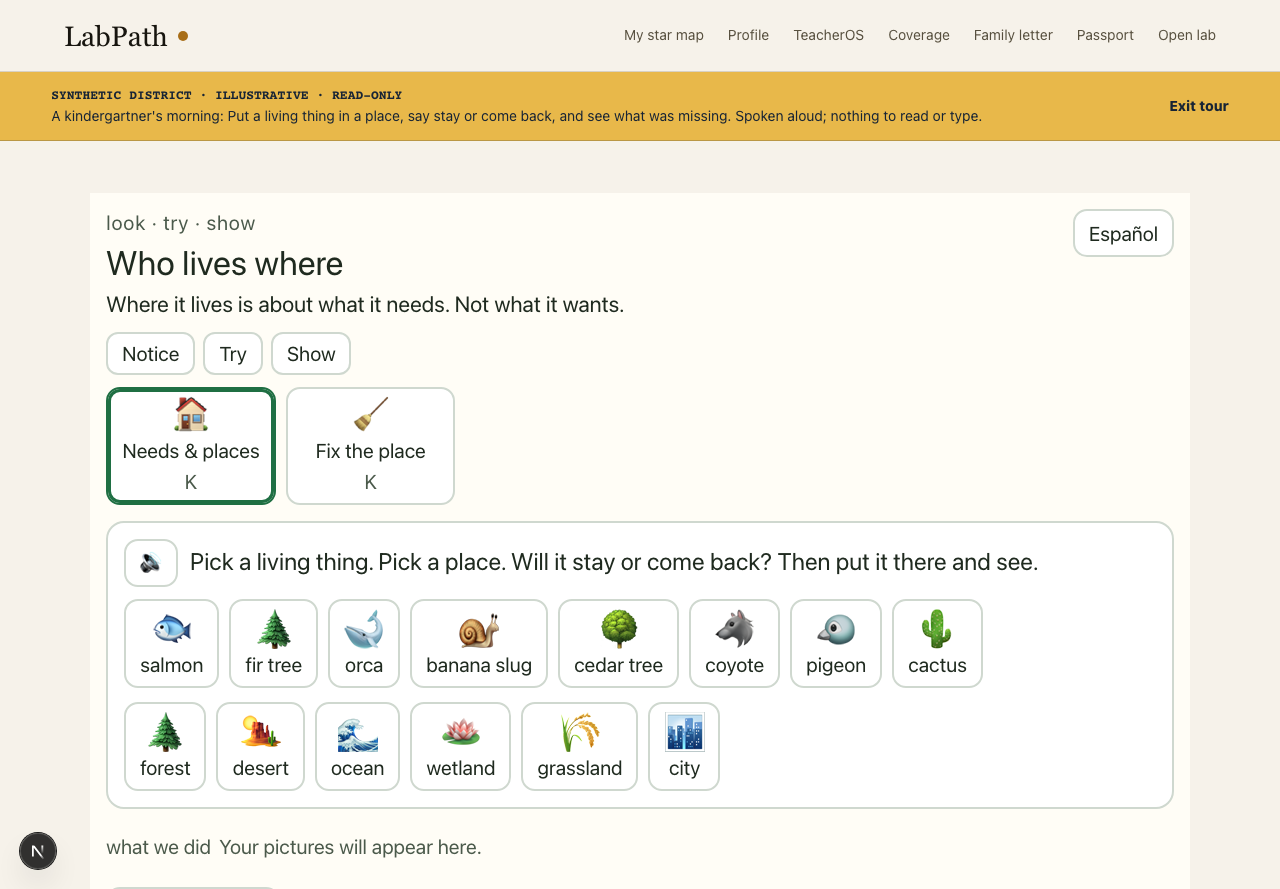
Young learners start with concrete objects, one action at a time, readable prompts, visible before/action/after consequences, and parent/TeacherOS evidence.

Open K-8 Math
Deep implementation

Algebra I LabPath

A complete Algebra I course where students learn algebra as a system of relationships: they model, manipulate, graph, test, explain, revise, and defend every important idea.

Open Algebra I
Deep implementation · 10/10

Geometry LabPath

A replacement-grade Geometry course where students construct, transform, measure, model, and prove. Every theorem becomes a visible invariant and every design decision becomes evidence.

Open Geometry
Deep implementation · 10/10

Algebra II LabPath

A replacement-grade Algebra II path where students learn functions, structure, modeling, uncertainty, and transfer through interactive evidence, not worksheet mimicry.

Open Algebra II
Advanced math expansion · 10/10

Precalculus, Calculus, Statistics, Undergrad Math

38 units and 114 missions extend the same evidence loop into advanced secondary and undergraduate foundations.

Start Precalculus
Freshman-year maps

Semester-scale paths that turn introductory courses into evidence-rich labs.

8course maps
120course-weeks
40unique V10 labs
Math

Freshman Mathematical Modeling LabPath

Use manipulatives, graphs, equations, and proof moves to model relationships and defend them.

15 weeks3 units9 labs
Model, Prove, Transfer: prediction, model action, observation, explanation
Science

Freshman Physical Science LabPath

Run controlled tests, observe physical consequences, and explain the mechanism with evidence.

15 weeks3 units9 labs
Mechanism to Evidence: prediction, controlled action, observation, measurement
Science

Freshman Life Systems LabPath

Intervene in cells, genes, organs, organisms, and ecosystems, then explain feedback over time.

15 weeks3 units8 labs
Living System Intervention Defense: prediction, intervention, observation, trend
Computer Science

Freshman Computing Systems LabPath

Trace systems, debug state, repair faults, and prove the fix with replayable evidence.

15 weeks3 units5 labs
Debug, Defend, Transfer: prediction, trace, repair, test
Engineering

Freshman Engineering Design LabPath

Operate engineered systems, tune constraints, see failure, and defend design tradeoffs.

15 weeks3 units6 labs
Digital Twin Design Review: prediction, actuation, failure trace, revision
History

Freshman Historical Evidence LabPath

Work inside evidence rooms, source documents, revise claims, and defend limits.

15 weeks3 units2 labs
DBQ Evidence Defense: source annotation, claim, counter-evidence, revision
ELA

Freshman Writing Evidence LabPath

Write claims that can survive source checks, counter-evidence, revision, and defense.

15 weeks3 units5 labs
Evidence-Backed Argument Portfolio: claim, source annotation, reasoning, counter-evidence
Workforce

Freshman Business and Professional Judgment LabPath

Make professional decisions, test consequences, and defend tradeoffs with evidence.

15 weeks3 units5 labs
Professional Judgment Evidence Record: prediction, decision, consequence, explanation
What makes it different

LabPath is not a video playlist. It is a lab-school runtime.

The unit of progress is not completion. It is demonstrated capability: prediction, action, observation, explanation, revision, transfer, and evidence.